
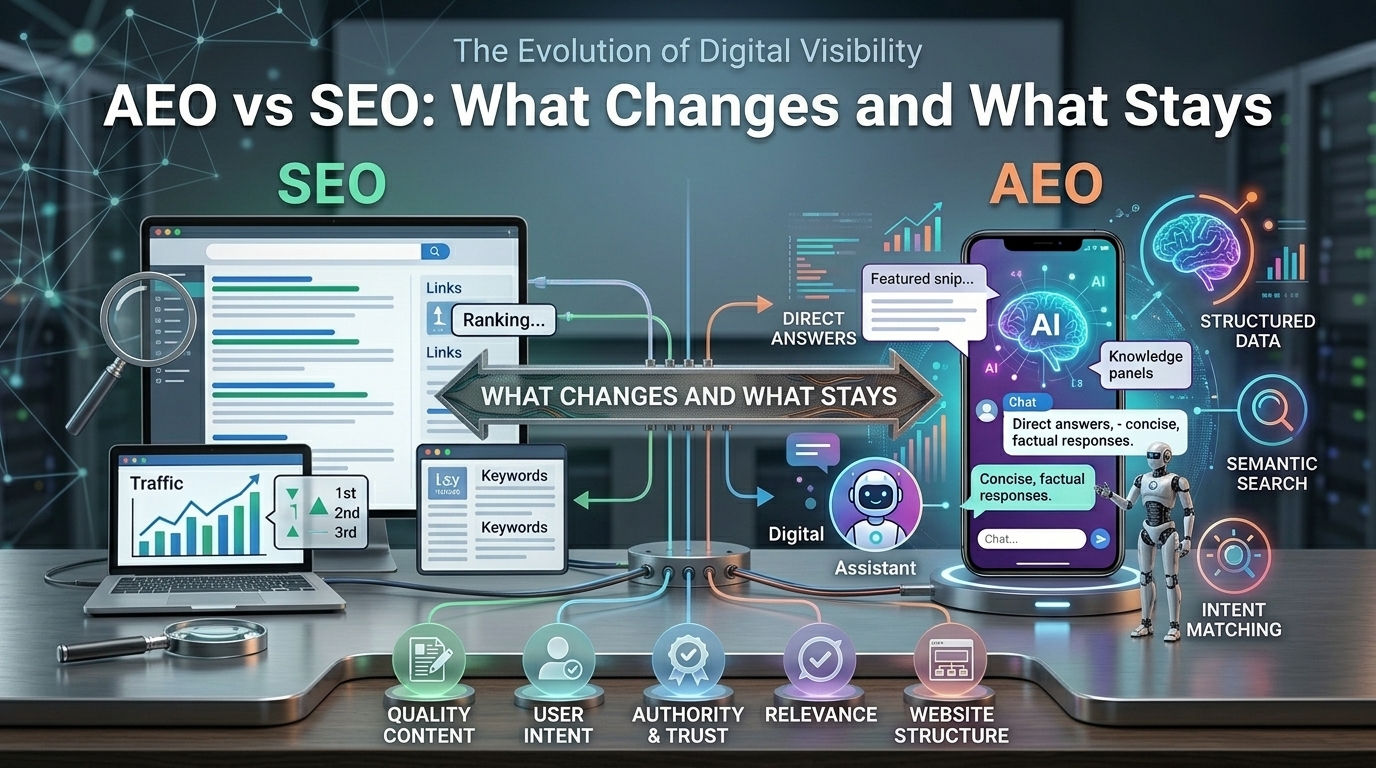
The panic across the marketing industry is palpable. With the rapid rollout of generative AI overviews and integrated AI search assistants, many are aggressively predicting the death of traditional search. But sophisticated growth leaders understand that search isn't dying; it is bifurcating.
We are witnessing the split between informational retrieval and experiential discovery. This shift demands a nuanced understanding of Answer Engine Optimization (AEO) versus traditional Search Engine Optimization (SEO).
AEO is fundamentally about satisfying immediate intent through synthesized, zero-click answers. SEO, in the modern context, is about driving deep discovery, capturing complex research journeys, and building unshakeable domain authority.
The organizations that win this next era of digital acquisition won't abandon SEO for AEO; they will skillfully integrate both into a unified growth strategy. Here is exactly what changes, and more importantly, what stays the same.
The Core Difference: Synthesized Answers vs. Deep Discovery
To navigate this transition, we first need to define the fundamental difference between the two frameworks.
Traditional SEO is built on the ten blue links model. A user queries an engine, the engine provides a ranked list of resources, and the user clicks through to evaluate the information. The goal of SEO was to be the most prominent, relevant, and authoritative link.
AEO fundamentally changes this contract. An Answer Engine (like ChatGPT Search, or Google's AI Overviews) bypasses the click. It crawls the web, synthesizes the information across multiple authoritative sources, and delivers a definitive, conversational answer directly on the results page.
If a query can be answered with a singular fact or a synthesized summary, an Answer Engine will take it. If a query requires deep evaluation, comparative analysis, or human experience, traditional SEO still rules the journey.
What Changes: The Shift from Clicks to Mentions
The most jarring change for marketing teams will be the metric of success for top-of-funnel (ToFu) informational content.
The Death of the Informational Click
For definitions, simple lists, and basic industry FAQs, you should expect your organic click-through rates to plummet. Answer engines will synthesize your "What is X?" pillar pages. But this is not necessarily a loss of revenue; it is a loss of vanity traffic. Those visitors were rarely converting anyway.
Optimizing for the LLM Context Window
Instead of optimizing solely to rank a page, you are now optimizing to be cited as an authoritative source by a Large Language Model (LLM). This means content must be structured meticulously. Clear hierarchical headings, precise definitions, and easily parsable data tables are no longer just "good for readability"—they are structural requirements for machine comprehension.
The Rise of Information Gain
If your content is simply a rewritten amalgamation of the top three Google results, an LLM has no reason to cite you. You offer zero "Information Gain." To be cited in an AI overview, your content must offer unique perspectives, proprietary data, or expert frameworks that the model cannot synthesize from generic sources.
What Stays: The Foundation of Entity Authority
While the interface of search is changing dramatically, the underlying mechanics of authority evaluation remain remarkably consistent.
Technical Excellence Is Non-Negotiable
An Answer Engine cannot synthesize what it cannot crawl. Technical SEO foundations—site speed, canonicalization, logical site architecture, and flawless mobile experiences—are more important than ever. If an AI bot hits a rendering roadblock on your site, you are immediately excluded from the training data and the synthesis pool.
Backlinks Still Serve as Trust Proxies
Despite the chatter, algorithmic trust still heavily relies on the link graph. An LLM needs to know which source to trust when synthesizing conflicting information. Backlinks from universally recognized, high-authority domains act as digital votes of confidence. While the nature of link building is evolving away from spammy outreach toward genuine digital PR, the weight of a powerful backlink remains a cornerstone of a solid SEO strategy.
Deep, High-Intent Content Converts
AI can tell a user what a CRM is. AI struggles to tell a manufacturing CFO which CRM is the most cost-effective for a legacy on-premise migration. Middle-of-funnel and bottom-of-funnel content—case studies, deep comparative analyses, and highly specific industry playbooks—will not suffer from zero-click outcomes. This is where your human expertise, un-replicable by AI, shines and converts.
Adapting Your Strategic Framework for 2026
The tactical execution of your marketing will shift, but the strategic goal remains identical: capture demand and drive pipeline.
Moving forward, your strategy must bifurcate successfully. For broad, top-of-funnel queries, focus on AEO: be structured, be clear, and be the definitive, easily synthesizable source so you are cited by the engines. For complex, high-intent problem queries, double down on traditional deep SEO: provide the human experience, the proprietary data, and the nuanced analysis that a buyer requires before making a purchasing decision.
Search is not dying; it is maturing. The organizations that adapt their architectures to feed machines while adapting their narratives to persuade humans will utterly dominate this next era of digital acquisition.